

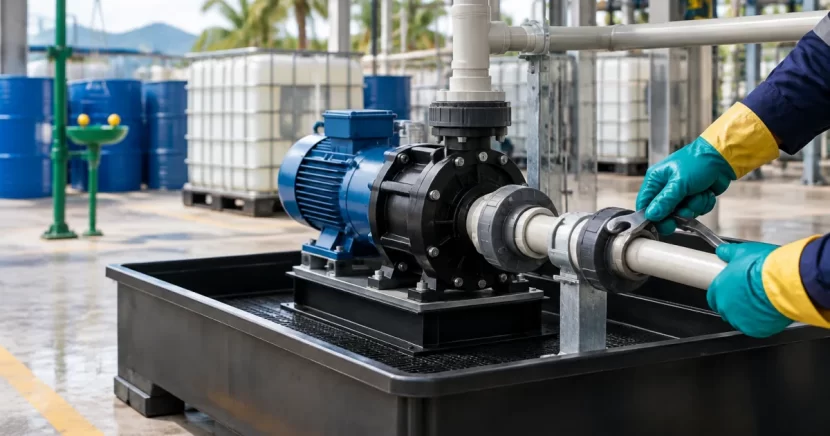
When your team is asked to source a chemical pump, the pressure to “get the best price” is real. But in most plants, the pump’s purchase price is only a small fraction of what you will pay over the next few years. The larger costs often show up later as unplanned downtime, leaks and cleanup, accelerated corrosion, repeated seal failures, hard-to-find spares, and maintenance hours that quietly grow.
This is why decisions driven mainly by the lowest quoted price are risky in chemical service. The cheapest pump is frequently the most expensive once you include total cost of ownership (TCO) and risk exposure. That doesn’t mean you must buy the most premium model; it means you should buy the most appropriate pump and support package for your duty, liquid, and site conditions.
For teams evaluating Chemical Pumps Malaysia suppliers, this article outlines a practical way to compare options beyond brochures and unit price. I’ll label what is fact vs opinion and focus on what plant managers, EHS leads, and maintenance/procurement teams typically need to decide.
The hidden bill: what “total cost” really includes
Fact: Purchase price is only one component of lifecycle cost. Even without rare “black swan” incidents, everyday operating costs can dominate lifetime spend.
Opinion (based on common plant experience): Many “cheap pump regrets” come from ignoring costs that don’t appear on the quotation. They surface later in a different budget (maintenance, production loss, EHS), so the trade-off is easy to miss during procurement.
When you compare pumps, include at least these cost buckets:
- Energy: motor power, hydraulic efficiency, whether the pump operates near its best efficiency point (BEP), and how often it runs throttled or off-design.
- Maintenance labor: routine checks, seal/diaphragm replacements, bearing changes, alignment, troubleshooting time.
- Spares and consumables: seals, diaphragms, O-rings, impellers, magnets/can assemblies, couplings, gaskets, lubricants.
- Downtime and production losses: planned shutdowns vs emergency stops, cleaning/decontamination, restart time, quality rejects after interruptions.
- Safety and compliance exposure: likelihood and consequence of leaks/splashes/fume release, corrosion damage to nearby assets.
- Installation and system costs: baseplate/skid work, piping modifications, strainers/filters, pulsation dampeners, VFDs, instrumentation, secondary containment.
- Supplier support: commissioning quality, troubleshooting response, documentation, spare lead time, and ability to diagnose system issues (not only sell hardware).
Several of these are driven by fit-for-duty engineering, not brand name alone. A high-quality pump in a poor system can still fail early; a correctly selected mid-range pump with good support can outperform a “bargain” pump chosen from flow/head only.
Why chemical duty is unforgiving (and why water-pump thinking fails)
Fact: “Chemical” is not one duty. Services vary by corrosivity, viscosity, temperature, solids, vapor pressure, crystallization/polymerization tendency, and compatibility with elastomers/plastics.
Opinion: Many low-price failures begin with a subtle mismatch: the pump meets flow/head on day one, but materials, sealing, or suction conditions are not robust for real variability.
Common ways water-service assumptions break down in chemical transfer:
- Materials compatibility is non-negotiable: A small elastomer mistake (swelling, hardening, embrittlement) can become chronic leakage.
- Sealing is a primary risk point: In corrosive/toxic service, even “minor” drips may be unacceptable. Seal selection and installation quality matter.
- Vapour pressure and NPSH margin: Many chemicals flash/outgas more readily than water, increasing cavitation and loss-of-prime risk if suction design is marginal.
- Crystallizing/polymerizing fluids: Dead-legs, heat loss, or low-velocity zones can form solids that damage diaphragms, bearings, or impellers.
- Operator handling reality: Hose connections, drum/IBC transfers, and intermittent starts/stops stress pumps differently than steady circulation.
If your application is actually industrial water, HVAC circulation, or boosting, a different pump category may be more appropriate. For chemical handling, design choices that reduce leakage and simplify maintenance often pay back quickly.
Price traps that create downtime (and why downtime is rarely “just one hour”)
Fact: Unplanned pump failures usually trigger more than repair time: isolation, draining, flushing, lockout/tagout, decontamination, cleanup, and verification often add hours.
Opinion: Downtime is underestimated because a pump swap is imagined like changing a motor. In chemical service, the safety/permit overhead can exceed the mechanical work.
Common low-price traps that increase downtime:
- Non-standard parts: “Cheap” pumps may use uncommon seals/bearings or proprietary components that aren’t locally stocked.
- Weak documentation: Missing drawings/exploded views/part IDs turns routine repair into a time-consuming search.
- Poor maintainability: Extra disassembly, special tools, or finicky reassembly extends MTTR.
- No commissioning support: Vibration, misalignment, or suction issues at start-up can cause early failures that get blamed on the pump.
- Wrong pump type for intermittent transfer: Using a centrifugal where self-priming/air handling is needed leads to repeated loss-of-prime trips and callouts.
Practical example: A site buys a low-cost mechanically sealed centrifugal unit for IBC-to-day-tank transfers. Operators sometimes run the tote near empty and pull air. Seal faces overheat during dry running, then the seal weeps. You don’t just buy a seal—you stop transfer, clean residue, issue permits, wait for parts, and re-brief operators. The “cheap pump” becomes a recurring outage generator.
Safety costs: a leak is not just a housekeeping issue
Fact: Chemical leaks can create injury risk, environmental exposure, corrosion damage, and reputational impact. Even small leaks can require containment, neutralization, and proper waste handling.
Opinion: Safety cost is often underweighted because it’s hard to convert into a line item—until an incident occurs. A procurement decision that raises leak probability isn’t saving money; it’s shifting risk to operations and EHS.
Where safety and pump design intersect:
- Seal vs sealless design: Mechanical seals can be reliable when selected/installed/supported correctly. If leak avoidance is paramount, sealless technology can reduce routine leakage points.
- Secondary containment: Drip trays/containment, compatible gaskets, and good hose management can turn a seep into a non-event.
- Material degradation as a warning: Discoloration, crazing, swelling, or softening of plastics/elastomers often signals incompatibility.
- Maintenance accessibility: If inspection is difficult, it gets postponed; postponement increases the chance of sudden failures.
Often the best safety investment is a better system: correct suction piping to avoid cavitation, stable mounting, earthing/bonding where required by site practice, and commissioning checks that confirm reality matches design intent.
Understanding pump options for chemical service (and where each one makes sense)
Fact: Different pump types manage risk differently. There is no universal “best chemical pump.”
Opinion: If you can clearly describe your liquid, duty cycle, suction conditions, and maintenance capability, the “right” option becomes easier to justify—even if it’s not the lowest upfront cost.
Magnetic drive pumps (sealless centrifugal)
Sealless magnetic drive pumps are often chosen when leakage reduction is a priority. This is why many buyers search specifically for Magnetic Drive Pumps Malaysia when comparing chemical transfer options.
- Where they shine: Corrosive/hazardous fluids where routine seal leakage is unacceptable; clean liquids; continuous transfer or circulation.
- Key selection checks: Containment shell/can material compatibility, temperature limits, dry-run protection strategy, and filtration/solids control.
- Cost reality: Upfront cost is often higher, but seal-spares and leakage-management effort can drop. Magnet/can assemblies aren’t trivial—spare strategy matters.
Mechanically sealed chemical centrifugal pumps
A broad category that can be a strong fit when engineered correctly.
- Where they shine: General chemical transfer; higher flows where centrifugal is efficient; sites comfortable managing seals.
- Key selection checks: Seal face materials/elastomers, flush/quenches as required by service, shaft deflection, alignment/baseplate rigidity.
- Cost reality: Often competitive upfront. TCO depends heavily on seal life, installation quality, and having the right spares available.
Air operated double diaphragm (AODD) pumps
AODD pumps are widely used for drum/IBC transfer, viscous liquids, intermittent duty, and applications where air-driven simplicity is valued.
- Where they shine: Intermittent transfer, viscous or shear-sensitive fluids, some solids-laden services (within limits), portable transfer where air ingestion is likely.
- Key selection checks: Diaphragm/ball/seat chemical compatibility, air quality and supply stability, pulsation management, and whether the process tolerates pulsating flow.
- Cost reality: The pump may be reasonably priced, but compressed-air cost can be significant. Diaphragms and check components are wear items—spares and maintenance discipline matter.
If AODD is on your shortlist, evaluate the supplier’s service support, not just the catalogue. For relevant options, see Air Operated Double Diaphragm Pumps.
Metering pumps and vertical pumps
For dosing accuracy or limited footprint, metering and vertical configurations may fit better than a standard end-suction centrifugal pump.
- Where they shine: Controlled dosing/injection; sumps/tanks where vertical immersion helps priming and space.
- Key selection checks: Control requirements, calibration needs, maintenance access, and compatibility with concentration changes.
Note: many searches for “vertical pump” or “vertical multistage” relate to water boosting/circulation rather than chemical transfer. Water-duty designs can work for some compatible chemicals if materials and sealing are specified correctly, but don’t assume suitability without a proper review.
Spares, lead times, and maintainability: the unglamorous TCO drivers
Fact: Spare parts availability and maintainability directly affect mean time to repair (MTTR) and downtime cost.
Opinion: Buyers sometimes overemphasize initial delivery lead time and underemphasize the spare-parts story. The result is a plant that starts up quickly but struggles to stay running.
When comparing offers, ask questions that expose the real spares strategy:
- What are the recommended critical spares? (Seal kits, diaphragms, bearings, O-rings, impellers, magnets, check valves.)
- Are parts standardized? Can one kit cover multiple installed pumps, or does each unit require unique spares?
- What is the local stock plan? Not a promise—an actual list of commonly stocked items.
- Can the pump be rebuilt on-site? Or does it require factory-level tooling?
- Is there a clear parts breakdown with part numbers? Critical during shutdown windows.
Practical example: Two pumps are quoted for the same duty. Pump A is cheaper but uses a proprietary cartridge seal with long lead time and a unique elastomer. Pump B costs more but uses a common seal family with locally stocked kits. If seals last 12–18 months, Pump B may still win on TCO because seal changes can be planned during routine stops instead of waiting weeks after a failure.
Selection mistakes that make a “cheap” pump look bad (even if the pump is fine)
Fact: Many pump failures are system-induced: poor suction piping, air ingress, operating far from BEP, inadequate flushing, poor support/anchoring, or misalignment.
Opinion: Low-price procurement increases the chance of system mistakes because the purchase is treated as a commodity transaction, not an engineered solution. A supplier who only sells a box can’t protect you from application and installation pitfalls.
High-frequency mistakes to check for:
- Insufficient NPSH margin: long suction runs, too many elbows, undersized piping, hot liquids, blocked strainers → cavitation and vibration.
- Dry running risk: drum/IBC transfers and intermittent suction increase loss-of-prime risk; select tolerant designs or add protection controls.
- Wrong materials “close enough”: the casing may resist the chemical, but O-rings, diaphragms, or seal faces may not.
- Off-design operation: oversizing and heavy throttling wastes energy and can accelerate wear/overheating.
- Alignment/baseplate shortcuts: soft foot, pipe strain, and poor coupling alignment drive seal/bearing issues that appear as “pump defects.”
Actionable approach: When requesting quotations, send more than flow/head. Provide chemical name and concentration range, temperature range, viscosity (if known), solids (if any), suction source (tank/IBC/drum), duty cycle, and sealing preference (sealless vs mechanical seal) with EHS context. If you can’t share exact chemistry, share compatibility requirements and the risk profile (corrosive/toxic/flammable) so the supplier can propose safer defaults.
A practical TCO checklist to compare quotations (use this before you approve PO)
Fact: You can evaluate lifecycle cost without perfect data by using structured questions and consistent assumptions across bids.
Opinion: A simple scoring model often beats an overly detailed spreadsheet. The goal is to make hidden costs visible and align production, maintenance, EHS, and procurement on what “value” means.
Use the checklist below to compare options side-by-side (for example, score each item 1–5 and note why).
| Category | What to check | Why it matters |
|---|---|---|
| Fit to duty | Compatibility, temperature, viscosity, suction condition, duty cycle | Prevents chronic failures from mismatched application |
| Leak risk | Seal plan or sealless design, containment, drain/vent provisions | Reduces EHS exposure, cleanup time, corrosion damage |
| Maintainability | Time to change seal/diaphragm, tools needed, accessibility | Lowers MTTR and shutdown extensions |
| Spares strategy | Critical spares list, local stock, interchangeability | Speeds recovery and makes maintenance predictable |
| Energy & utilities | Efficiency at operating point; air use (AODD); need for VFD | Avoids “cheap to buy, expensive to run” outcomes |
| Supplier capability | Site survey, diagnostics, commissioning, troubleshooting support | Prevents system-induced failures and speeds root-cause resolution |
| Documentation | Datasheets, curves, IOMs, exploded views with part numbers | Enables correct install and fast ordering/repair |
Practical example: If leakage cannot be tolerated, score sealless (or robust seal support) higher. If transfer is intermittent and operators often run containers low, AODD may score higher because it is more forgiving of air ingestion (with correct materials).
How to buy smarter: align procurement, maintenance, and EHS before selecting a supplier
Fact: Pump procurement is cross-functional. Operations and maintenance live with the consequences even if procurement owns the purchase.
Opinion: The best outcomes happen when the team agrees upfront on what “failure” means (leakage, downtime hours, repeated seal replacements) and what trade-offs are acceptable (capex vs opex vs risk).
A workflow that reduces “lowest price” regret:
- Define the risk tier: hazardous/corrosive/toxic? Is any leakage acceptable? What is the consequence of a 4-hour outage?
- Standardize where possible: standard pump families and spare kits often beat one-off bargains.
- Require duty confirmation: supplier confirms operating point, materials, sealing method, and constraints (solids, vapor, dry running).
- Plan spares at purchase: buy initial critical kits with the pump, especially where procurement lead time is tight.
- Commission properly: verify alignment, rotation, suction condition, valve line-up, and baseline vibration/noise; add simple gauges/flow indication where practical.
- Close the loop with maintenance data: track failure causes and adjust specs next time (for example, early diaphragm failure may indicate compatibility or pulsation issues).
If you want to compare categories and configurations in one place, review available Chemical Pump options and discuss selection and support expectations with a technical supplier rather than buying purely on a quotation line.
Conclusion: the cheapest pump is often the costliest decision
Fact: In chemical service, failure modes involve more than mechanics—leakage, materials compatibility, operator handling, and system design all matter.
Opinion: If you evaluate TCO, safety exposure, downtime impact, and spare-parts strategy, you’ll usually make a more defensible decision than picking the lowest upfront price. Not every application needs a premium pump, but every chemical application needs a fit-for-purpose solution backed by solid technical practices.
When comparing quotes, don’t ask only “Which pump is cheapest?” Ask: “Which option keeps the plant running with the lowest total risk and the most predictable maintenance?” That is where real savings come from.
Frequently Asked Questions
How do I compare chemical pump quotations beyond the upfront price?
Compare total cost of ownership (TCO): expected maintenance frequency, critical spares cost and availability, downtime risk (MTTR), energy or compressed-air usage, and leakage/safety exposure. Ask each supplier to confirm duty assumptions (chemical, concentration range, temperature, suction condition, and duty cycle) and provide a recommended spares list with part numbers.
When should I consider a sealless magnetic drive pump instead of a mechanically sealed pump?
Consider sealless magnetic drive pumps when minimizing routine leakage is a priority (hazardous/corrosive chemicals) and the liquid is relatively clean and stable for centrifugal pumping. Still check material compatibility, temperature limits, and how you will prevent or detect dry running, because sealless designs can be sensitive to overheating if run without proper liquid flow.
Are AODD diaphragm pumps good for chemical transfer in factories?
Often yes—AODD pumps can be a practical choice for drum/IBC transfer, intermittent operation, viscous fluids, or situations where occasional air ingestion is likely. The key is selecting the right diaphragm and check-valve materials for chemical compatibility, and understanding that compressed-air operating cost and pulsation effects are part of the lifecycle trade-off.
What spare parts should we keep for chemical pumps to reduce downtime?
It depends on pump type, but commonly: seal kits (or diaphragm kits for AODD), O-rings/gaskets, bearings, impellers, check balls/seats, and any proprietary components such as magnet/can assemblies for magnetic drive pumps. The most useful approach is to standardize pump models where possible so one spare kit supports multiple installed units.
Can a vertical multistage centrifugal pump be used for chemicals?
Vertical multistage centrifugal pumps are widely used for clean water boosting and circulation, and they can be used for certain compatible chemicals if materials and sealing are correctly specified. However, many chemical services need corrosion-resistant materials, careful elastomer selection, and leak-risk management—so treat it as an engineered selection rather than assuming a water-duty design will be suitable.
Need a chemical pump that stays reliable after commissioning?
M.E.T. Motion Engineering & Trading Sdn. Bhd. supports plant teams with more than just pump supply—selection assistance, complete pump system fabrication, installation, testing & commissioning, plus maintenance and repair support. If you’re comparing options and want to evaluate TCO, safety, downtime risk, and spares strategy for your chemical transfer duty, talk to our technical team for a practical recommendation.
