

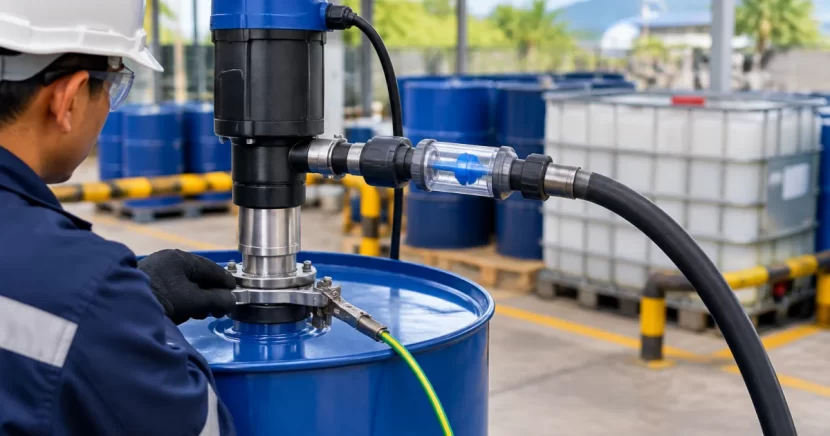
Drum handling is no longer just “get it out of the drum.” In 2026, many Malaysian chemical stores, factories, and lab/production teams treat drum-to-process transfer as a safety and quality control point—especially when moving from 200L drums into day tanks, dosing skids, reactors, IBCs, or process headers.
As a result, Drum Pumps Malaysia buyers are moving away from open, splash-prone methods and toward controlled transfer setups built around three upgrades:
- Sealed (closed) systems to reduce fumes, splashes, and contamination
- Grounding and bonding to reduce static-related ignition risk where applicable
- Metering (inline flow measurement) to improve accuracy, repeatability, and loss control
Below is what these upgrades look like in real operations, which components matter, and what to confirm with a supplier when you plan an upgrade.
Why drum-to-process transfer is being redesigned
Facilities typically upgrade because recurring issues create safety risk and operational cost:
- Operator exposure from open lids, decanting, or improvised funnels
- Spills and housekeeping that lead to cleanup time, corrosion, and disposal costs
- Product integrity risks from water, dust, or cross-contamination
- Batch repeatability problems when volume is estimated instead of measured
- Reliability issues caused by wrong materials, poor priming, or unsuitable hoses
That is why many teams now specify a mini system—pump, sealed interface, grounding/bonding, metering, plus the correct hose/valves—instead of buying “just a pump.”
Trend #1: Sealed transfer setups (closed drum adapters and vapor control)
A sealed drum transfer setup typically uses a drum pump installed through a closed drum adapter or lid system, reducing splashes and limiting exposure. Done properly, it also helps control fumes and contamination during transfer.
What “sealed” means in practice
- Closed drum adapter so the pump tube enters through a sealed interface (not an open bung/lid)
- Compatible gaskets matched to the chemical and temperature (a common leak point)
- Controlled venting/return where needed to prevent drum vacuuming and manage vapors—especially at higher flow or with viscous fluids
- Drip-minimizing shutoff via valves or couplers to reduce hose hold-up at the end of transfer
Common selection pitfalls
- Ignoring the interface: confirm drum type (steel/HDPE), bung size, and adapter fit early
- Not accounting for viscosity/suction conditions: what works for thin solvents may struggle with resins, syrups, or additives; alternatives such as diaphragm/AODD unloading may suit some duties
- Under-specifying the hose: chemical incompatibility or kinking often becomes the weakest link
Trend #2: Grounding and bonding as standard accessories (not an afterthought)
Grounding and bonding are increasingly specified as part of drum transfer kits—particularly with flammable liquids, low-conductivity fluids, or solvent cleaning operations. The biggest improvement comes when the controls are built into the routine, not left as “operator discretion.”
What facilities are standardizing
- Bonding clamps and leads to connect drum, pump, and receiving vessel during transfer
- Dedicated grounding points that are obvious and easy to use (reducing improvised clamp locations)
- Simple pre-start checks (visual confirmation and continuity checks if site practice requires it)
Material and configuration notes
Specify the full path—drum/adapter, pump body, hose, couplers, and receiving vessel—so components function as a system. A capable supplier should help confirm compatibility and practical implementation, not just sell individual parts.
Trend #3: Metering moves from “nice-to-have” to “operational control”
Inline flow measurement is being adopted because it turns transfer from an estimate into a controlled operation. Beyond “billing,” it supports batch accuracy, repeatability between shifts, and loss tracking.
Where metering delivers quick value
- Batch preparation: transfer a known quantity to a mixing tank without guesswork
- Inventory/loss control: compare what left the drum to what reached the vessel and spot abnormal losses
- Operator repeatability: a consistent reference across teams and shifts
- Troubleshooting: flow behavior can indicate restrictions, blocked strainers, or viscosity changes
This is also why some buyers evaluate broader specialty pumps & flowmeters packages, aiming for a single supplier who can advise on compatibility and integration.
Choosing a meter for drum transfer
- Chemical compatibility (meter body and seals)
- Flow range suitable for your expected operating window
- Pressure drop impact, especially with higher viscosity fluids
- Cleaning approach (flush/rinse routine or dedicated hose sets)
How to specify a safer drum pump transfer system (a practical checklist)
For upgrades, treat drum transfer like a small engineering package: define the duty first, then build the equipment list around it.
Step 1: Define the application clearly
- Fluid name and concentration/chemical family, plus temperature
- Viscosity behavior (thin, thick, variable)
- Required flow rate and target transfer time
- Transfer distance and elevation (floor drum to tank top, drum to IBC, etc.)
- Location and ambient conditions (indoor/outdoor)
- EHS expectations (fumes/odour control, PPE, containment practice)
A supplier with pump diagnostic & consulting capability can often resolve bottlenecks that are not “fixed” by a bigger pump (for example, hose routing, suction conditions, or a better-suited pump type).
Step 2: Choose the pump type that matches the risk and duty
- Drum pump (electric or air motor driven) for efficient drum unloading with tube/motor combinations
- Air Operated Double Diaphragm Pumps where air drive, dry-run tolerance, gentle pumping, or variable viscosity handling is beneficial
- Chemical pumps (mag drive, mechanically sealed, metering pumps) when drum transfer ties into dosing or circulation loops
Many sites combine technologies—for example, a drum pump into a day tank, then a metering pump for controlled dosing. Utility areas may involve separate duties (such as an industrial water pump), but expectations remain the same: reliable, maintainable, and safe operation.
Step 3: Build the sealed interface and accessories around the pump
- Closed drum adapter/lid system matched to drum bung and drum material
- Chemically compatible hose and appropriate clamps/couplers
- Isolation valve and (where needed) non-return valve
- Inline strainer where particulate risk exists (balanced against pressure drop)
- Containment details that fit site practice (for example, drip trays)
Step 4: Add grounding/bonding and metering with the workflow in mind
Accessories work only when they are easy to use: place clamps where operators can reach them, and place the meter where it is visible at the control point. If the kit moves between drums, keep hose length and weight manageable.
Step 5: Plan commissioning and maintenance from day one
- Acceptance checks (leak test, flow verification, meter repeatability)
- Spare seals/gaskets and a simple preventive schedule
- Training for clamp placement, flushing/cleaning, and shutdown
For production-critical transfer points, buyers often prioritize suppliers who can provide installation, testing & commissioning support and ongoing pump maintenance & repair.
Where to source safer transfer packages in Malaysia (what to look for in a supplier)
Because safer transfer upgrades involve multiple parts, outcomes are often better when one partner can supply and support the full package: pump, sealed interface, accessories, and service.
Useful qualification questions include:
- Can you recommend suitable materials for pump tube, seals, hose, and meter body based on our chemicals and temperature?
- Can you propose a sealed drum adapter solution for our drum type (steel/HDPE) and bung size?
- Can you include grounding/bonding accessories and advise on workflow implementation?
- Do you support troubleshooting, repair, and spare parts locally?
- Can you fabricate a complete transfer set (valves, meters, hose management, mounting) to our layout?
If you want to review common drum transfer configurations, see Fti Drum Pumps for drum pump solutions and accessories. For air-driven options, see Air Operated Double Diaphragm Pumps. For broader transfer and dosing approaches, see the Chemical Pump range.
Conclusion: the “safer transfer” shift is a system upgrade, not a pump swap
The 2026 shift is clear: drum transfer is being redesigned around sealed handling, static control, and measurable flow. The goal is not simply a higher-spec pump; it is a transfer system that matches your fluid, your operators, and your safety and repeatability requirements.
Start by mapping current pain points (spills, fumes, inconsistent batches, frequent stoppages). Then work with a supplier who can match materials correctly, integrate sealed adapters and metering, and support commissioning and maintenance. Done well, the transfer point becomes cleaner, safer, and more consistent day after day.
Frequently Asked Questions
What is the difference between an open drum transfer and a sealed drum transfer setup?
Open transfer typically involves opening the drum and decanting or pumping with minimal containment, which increases splash, fume, and contamination risk. A sealed setup uses a closed drum adapter (with compatible gaskets) so the pump tube enters through a sealed interface, helping reduce exposure, leaks, and product contamination during drum-to-process transfer.
Do I need grounding and bonding for drum pumping?
Many facilities specify grounding and bonding when handling flammable liquids or where static discharge is a concern. The idea is to bond the drum, pump, and receiving vessel so they remain at the same electrical potential during transfer. Your site’s EHS requirements and the fluid properties should guide the final requirement, and the accessories should be integrated into the workflow so operators can use them consistently.
When should I choose a diaphragm pump (AODD) instead of a drum pump?
An air operated double diaphragm (AODD) pump can be a better option when you need air-driven operation, gentle pumping, dry-run tolerance, or the ability to handle variable viscosity and some solids. Drum pumps are often chosen for efficient drum unloading and straightforward operation. The best choice depends on fluid compatibility, required flow rate, transfer distance, and how the transfer point is operated day to day.
How do I add metering to a drum transfer line without making it complicated?
Use an inline flowmeter that matches your chemical compatibility requirements and expected flow range, and place it where the operator can see it while controlling the transfer. Pair it with practical accessories like an isolation valve and suitable hose/couplers. Keep the workflow simple: connect, clamp/ground if required, reset the meter, transfer, then flush or clean according to your plant practice.
What information should I prepare before requesting a drum pump system quotation in Malaysia?
Prepare the fluid details (chemical family/concentration, temperature), viscosity behavior, desired flow rate and transfer time, suction/discharge distance and elevation, drum type and bung size, and any preferences for sealed adapters, grounding/bonding, and metering. Sharing these details helps the supplier propose the correct pump materials, hose specification, and a safer closed transfer configuration.
Need a safer sealed drum transfer package for your plant?
M.E.T. Motion Engineering & Trading Sdn. Bhd. supports Malaysian sites upgrading drum-to-process transfer with the right pump selection, sealed drum adapters, grounding/bonding accessories, inline metering options, and complete set fabrication.
If you want help matching materials to your chemicals, reducing leaks and exposure, or commissioning a more repeatable transfer workflow, speak to our technical team for a practical recommendation.
