

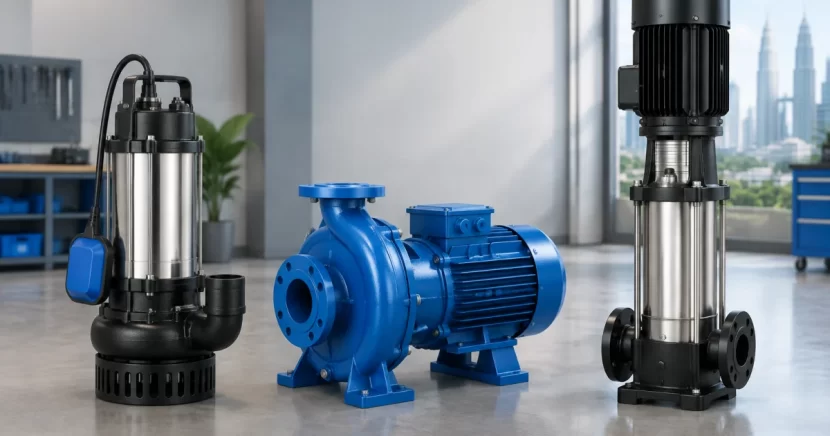
If you are comparing Water Pumps Malaysia suppliers and models for a building, factory, or small infrastructure project, start with pump type before brand. Submersible, end-suction centrifugal, and vertical multistage pumps can all move water, but the wrong match can cause low pressure, frequent tripping, noise, cavitation, or avoidable maintenance.
This beginner guide explains the three categories in plain language, then gives a practical first-pass checklist so facility managers, building operators, developers, and contractors can shortlist options before requesting a detailed pump curve selection.
Start with the basics: flow, head, and where the pump will live
Most quotations and datasheets revolve around three fundamentals:
- Flow rate: water volume you need to move (m3/h, L/min).
- Head / pressure: how hard the pump must push (m head, bar) based on lift and pipe resistance.
- Duty point: your normal operating combination of flow + head.
Next, confirm site realities that narrow your choices fast:
- Wet installation (in a sump/pit/tank) vs dry installation (pump room on a base).
- Flood risk and how critical continuous pumping is.
- Water quality: clean water, dirty water/solids, or chemically aggressive fluid.
Each pump type has a sweet spot: submersibles suit wet pits and difficult suction conditions, end-suction centrifugal suits accessible pump rooms, and vertical multistage is commonly chosen when higher pressure is needed in a compact footprint.
Submersible pumps: best when the source is below ground or in a sump
A submersible pump operates underwater with a sealed motor and pushes water up into the discharge piping. It is a common solution when the pump must sit below the waterline or when suction lift and priming are risky for a dry pump.
Where submersibles are commonly used
- Basement drainage/flood mitigation sumps
- Sewage and wastewater pits (solids-handling designs)
- Industrial drainage, utility pits, construction dewatering
- Lift duties where a dry pump would struggle to maintain prime
Pros and trade-offs
- Pros: no priming needed; quieter above ground; useful where there is no space for a pump room.
- Trade-offs: maintenance requires retrieval/lifting; cable and sealing quality matters; solids applications require correct impeller/hydraulics to avoid clogging.
Beginner tip: for sewage/solids, do not treat all submersibles as interchangeable. Frequent “trips” and poor performance are often caused by clogging or the wrong impeller type, not purely electrical issues.
Centrifugal pumps (end-suction): the go-to for general water transfer
In many projects, “centrifugal pump” refers to a dry-installed, end-suction pump coupled to an electric motor. It is popular because it is widely available, cost-effective, and suitable for many clean-water duties such as circulation and general transfer.
When reviewing Centrifugal Pumps Malaysia options, focus on matching the pump curve to your duty point (not pipe size alone). Materials, seals, and efficiency vary significantly across models.
Where centrifugal pumps fit well
- General transfer between tanks with stable suction conditions
- Cooling/process utility water circulation
- HVAC circulation loops (subject to temperature and system design)
- Fire-related services are a separate, standards-driven design case; consult specialists
Pros: easy access for inspection and servicing
- Pros: easy access for inspection and servicing; broad range of sizes; straightforward integration with valves and instrumentation.
- Trade-offs: needs correct suction/NPSH to avoid cavitation; many are not self-priming; mechanical seals depend on correct installation and operation.
Beginner tip: if the pump must draw from an underground tank through a long suction line, a standard end-suction centrifugal pump may be unreliable unless suction design is excellent. In such cases, a submersible arrangement or a different configuration can reduce risk.
Vertical multistage pumps: compact choice for high pressure and booster duties
A vertical multistage pump uses multiple impellers in series to build higher head (pressure). It is commonly selected for clean-water booster duties where steady pressure and a small footprint matter.
Where multistage pumps are commonly used
- Building domestic water booster sets
- RO feed, filtration skids, clean-water pressurisation
- Moderate-flow duties needing higher pressure
- Sites with limited floor space but strict pressure requirements
Pros: strong pressure capability in a compact
- Pros: strong pressure capability in a compact vertical form; pairs well with variable speed control for stable pressure.
- Trade-offs: dirty water/solids accelerate wear; alignment and piping stress control are important; materials must suit the liquid and environment.
Beginner tip: avoid selecting “extra head” just because it is available. Oversized head can waste energy and increase stress on valves, fittings, and controls.
A practical selection checklist (beginner-friendly)
Use this as a first-pass screen before requesting a detailed selection:
1) Identify the water source and suction conditions
- Sump/pit/tank below floor level: start with a submersible pump.
- Stable flooded suction in a pump room: end-suction centrifugal is often suitable.
- Long suction line, air ingress, or uncertain prime: consider submersible or specify self-priming where appropriate.
2) Decide whether pressure or simplicity is the priority
- Higher pressure in compact space: shortlist vertical multistage.
- General transfer + easy servicing: shortlist end-suction centrifugal.
- Reliable lifting from low points: shortlist submersible.
3) Check water quality: clean, dirty, or corrosive
Clean water can suit all three types depending on duty and installation. For dirty water/solids, start with a solids-handling submersible design.
If the liquid is chemically aggressive (acids/alkalis/solvents or process chemicals), treat it as a chemical-duty selection rather than forcing a standard water pump to cope. Materials, sealing, and safety requirements may change substantially.
4) Consider maintenance access and downtime tolerance
- Frequent access and a pump room: dry-installed centrifugal is usually simplest to service.
- Pump in a pit: plan guide rails, lifting points, isolation valves, and safe retrieval from day one.
- Critical, stable pressure for occupants/process: multistage booster configurations with proper controls are common.
5) Think about controls: on/off vs variable speed
Booster systems often use variable speed drives to maintain stable pressure and reduce energy waste (commonly with vertical multistage pumps, but other configurations exist). For drainage/sump duties, level switches or sensors are typical; good level control helps prevent rapid cycling that shortens motor life.
Common beginner mistakes (and how to avoid them)
- Choosing by pipe size only: confirm your duty point and review the pump curve.
- Ignoring cavitation/NPSH: poor suction conditions create noise, vibration, and long-term damage.
- Assuming more stages is always better: target required head with sensible margin, not excessive head.
- Underestimating water quality: clean-water pumps on dirty water fail early; specify solids/abrasion handling when needed.
- Forgetting service planning: submersibles need practical lifting and isolation provisions.
For faster and more accurate supplier selection, prepare a simple summary: liquid type, temperature (if relevant), estimated flow, estimated head, wet/dry installation, suction source, discharge destination, operating hours, and any known issues (clogging, low pressure, frequent trips).
Conclusion: match pump type to site realities, then refine the model
To shortlist quickly, match pump category to your constraints first, then refine sizing. Choose submersible pumps for sumps/low points or difficult suction conditions, end-suction centrifugal pumps for accessible pump rooms and general transfer, and a vertical multistage pump when you need higher pressure in a compact booster-style setup with clean water.
Once the type is clear, final selection should confirm the pump curve at your duty point, suitable materials and seals, and controls that match operating hours and maintenance expectations. Early technical input often prevents oversizing, repeated failures, and persistent low-pressure complaints.
Useful next reads: explore water pump options for common applications, or if your site transfers viscous or difficult fluids, review Air Operated Double Diaphragm Pumps for non-electric, air-driven transfer scenarios.
Frequently Asked Questions
How do I choose between a submersible pump and a centrifugal pump for a basement sump?
If the pump will sit inside a sump or pit and the water level rises and falls, a submersible pump is usually the simplest and most reliable choice because it does not depend on suction priming. A dry-installed centrifugal pump can work only when suction is properly designed (short, well-sized suction piping, minimal air ingress, and good net positive suction conditions). For many basements, space and suction limitations make submersibles the practical option—just plan proper lifting, guide rails (if needed), and isolation valves for maintenance.
What is a vertical multistage pump used for in buildings?
A vertical multistage pump is commonly used for booster duties where consistent pressure is needed, such as domestic water supply boosting to upper floors, filtration/RO feed, or clean-water pressurisation. The multistage design builds higher head (pressure) in a compact vertical footprint, which is helpful when pump room space is limited. Clean water and correct installation (alignment and low piping stress) are important for long service life.
Are centrifugal pumps self-priming?
Many standard end-suction centrifugal pumps are not self-priming. They generally require a flooded suction or a primed suction line to operate correctly. If air enters the suction line, a non-self-priming pump may lose prime and stop moving water. If your application has a long suction lift, frequent air pockets, or an intermittent supply, discuss self-priming requirements or consider a submersible arrangement.
When should I consider pump maintenance or a water pump repair service in Malaysia?
Consider inspection or repair if you notice repeated tripping, unusual noise or vibration, loss of pressure/flow, frequent seal leakage, or rapid on-off cycling. Early maintenance can prevent secondary damage to bearings, seals, motors, and couplings. If the pump is part of a critical building or plant utility, scheduling preventive checks (alignment, electrical condition, performance verification, and wear inspection) is often more cost-effective than waiting for an outage.
Do AODD (air operated double diaphragm) pumps replace water pumps?
Not usually. AODD pumps are great for certain transfer tasks—especially when the fluid may be viscous, contains solids, needs gentle handling, or when compressed air operation is preferred for safety or portability. However, for continuous clean-water circulation or high-efficiency booster duties, centrifugal or multistage water pumps are commonly more energy-efficient. Many sites use both: water pumps for main utility duties and AODD pumps for specific transfer or chemical/maintenance tasks.
Need help selecting the right pump type for your site?
M.E.T. Motion Engineering & Trading Sdn. Bhd. supports facility teams, contractors, and industrial operators with end-to-end pumping solutions—pump selection, complete pump system fabrication, installation, testing & commissioning, plus ongoing pump maintenance & repair.
If you can share your basic duty requirements (source, flow, pressure/head, water condition, and installation constraints), our technical team can help shortlist a suitable submersible, centrifugal, or vertical multistage configuration and advise on practical maintenance planning.
